


What Are the Best China Diamond Pads for Concrete?
Choosing the best China Diamond Pads for concrete is not simply a matter of finding the lowest price. Performance depends on the concrete’s hardness, aggregate, moisture, finish, and the polishing machine being used. A pad that cuts quickly on soft concrete may glaze over on a dense industrial floor. The opposite can also happen.
Real job conditions reveal these differences. On a warehouse floor, coarse metal-bond tools may remove scratches and surface coatings. Resin-bond Diamond Pads usually follow during honing and polishing. Grit selection matters, but so do segment shape, bond formulation, cooling, and dust control. Wet polishing can reduce heat and improve tool life, while dry polishing may save cleanup time. The correct choice depends on the project.
Reliable Chinese manufacturers should provide clear grit charts, bond options, product dimensions, and machine compatibility. Factory testing, batch consistency, and responsive technical support deserve equal attention. Certifications can support trust, but they should not replace sample trials or performance records. Ask for test results on concrete similar to yours.
No pad is perfect. A product described as “long-lasting” may cut too slowly for a tight schedule. A highly aggressive pad may leave deeper marks than expected. That assumption can fail. Before placing a large order, test several Diamond Pads on a small floor section. Record cutting speed, scratch pattern, heat, dust, and pad wear. This practical comparison offers stronger evidence than impressive catalog language and helps identify the best China Diamond Pads for concrete with greater confidence.
What Are Diamond Pads for Concrete and How Do They Work?
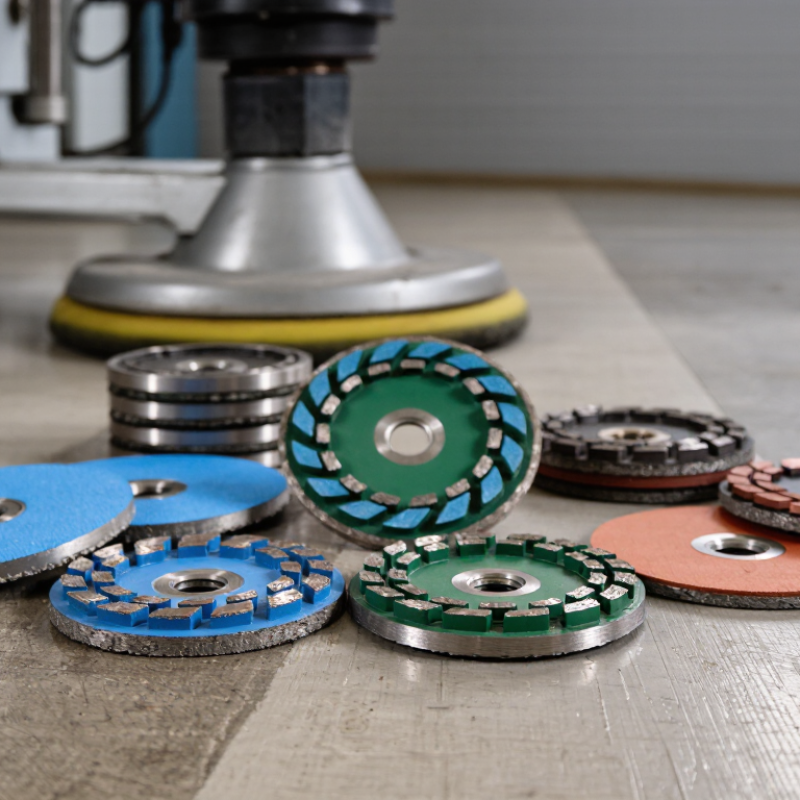
Diamond pads for concrete are flexible abrasive tools used to grind, hone, or polish cement surfaces. They contain industrial diamonds fixed in a metal or resin bond. These diamonds cut the concrete instead of merely scratching it.
The process begins with coarse pads that remove paint, stains, uneven areas, and weak surface paste. Finer pads then reduce visible scratches and develop a smoother finish. Metal-bond pads usually handle aggressive grinding. Resin-bond pads are better for honing and polishing. Water can control dust and cool the working surface, while dry grinding needs suitable dust extraction.
Pad selection depends on concrete hardness, surface damage, and the desired finish. A soft concrete floor may wear a pad quickly, while hard concrete can make the diamonds work slowly. I have found that testing a small area reveals more than relying on a general grit chart. Watch the scratch pattern.
Do not rush the stages. Moving to a finer grit too early can trap deep scratches beneath the final finish. I still find this easy to overlook on large floors. Keep the machine moving steadily, clean the surface between grits, and check the floor under strong side lighting. Small defects become obvious there. Proper pressure, speed, water control, and dust collection affect both the pad life and the finished appearance.
What Are the Best China Diamond Pads for Concrete? — What Are Diamond Pads for Concrete and How Do They Work?
| Pad Category | Typical Grit | Main Purpose | Recommended Concrete Condition | Wet or Dry Use | Expected Result | Key Selection Factors |
|---|---|---|---|---|---|---|
| Metal-Bond Grinding Pad | 16–30 | Removes surface irregularities, laitance, old coatings, and minor adhesive residue. | Rough, uneven, or heavily contaminated concrete; suitable for initial preparation. | Dry or wet | Fast material removal with a visibly scratched, coarse surface. | Use a harder bond for soft concrete and a softer bond for hard, dense concrete to help prevent glazing. |
| Metal-Bond Refining Pad | 40–80 | Levels grinding marks and continues removal of thin coatings or surface defects. | Concrete that has already been opened with a coarse grinding step. | Dry or wet | A more even surface prepared for resin tools or a coating system. | Select the grit according to the depth of scratches left by the previous step. |
| Hybrid or Transitional Pad | 50–100 | Bridges the change from aggressive metal tools to finer resin pads. | Prepared concrete with moderate grinding marks that require further refinement. | Usually dry | Smoother scratch pattern and improved consistency before polishing. | Useful when a direct change from metal to resin causes excessive scratching or uneven wear. |
| Resin Polishing Pad | 100–200 | Removes fine scratches and begins developing a low to satin sheen. | Sound concrete with the major defects already removed. | Wet or dry | Refined surface with reduced visible tooling marks. | Keep the floor clean between grits; leftover coarse particles can create deep random scratches. |
| Fine Resin Polishing Pad | 400–800 | Refines the surface and increases clarity, smoothness, and light reflection. | Previously refined concrete with a uniform scratch pattern. | Wet or dry | Satin to semi-gloss appearance, depending on the concrete and process. | Use consistent machine pressure and overlapping passes to avoid patchy gloss. |
| High-Polish Pad | 1,500–3,000 | Produces the final high-gloss finish and improves visual clarity. | Dense, clean, and fully refined concrete with no obvious coarse scratches. | Usually dry | High-reflectivity polished concrete surface. | High grit alone cannot correct deep scratches; return to a lower grit when defects remain visible. |
| Maintenance and Burnishing Pad | 800–3,000+ | Restores gloss, removes light scuffs, and supports routine floor maintenance. | Existing polished concrete in good condition with minor wear. | Dry | Renewed gloss and improved surface appearance without aggressive grinding. | Choose a pad compatible with the floor finish, machine speed, and cleaning procedure. |
| Edge and Detail Pad | 30–3,000 | Works along walls, columns, steps, corners, and other areas inaccessible to large machines. | Perimeter sections or detailed areas requiring the same progression as the main floor. | Dry or wet | More uniform edge-to-field appearance. | Match the grit sequence used on the main floor and use suitable backing equipment. |
Note: Diamond grit numbers are commonly used as a general indication of abrasive coarseness, but grading systems can vary by manufacturer. Actual performance depends on concrete hardness, aggregate type, pad bond, machine speed, operating pressure, dust control, and the use of water.
Related Posts
-
7 Best Diamond Pads for Concrete Polishing?
-

10 Essential Tips for Using Diamond Pads Effectively?
-
Why Choose Diamond Pads for Superior Surface Finishing?
-
Top 10 Diamond Pads for Quality Polishing Tools?
-
How to Choose the Best Diamond Pads for Your Needs?
-
Best Wet Diamond Polishing Pads for Perfect Finishes?


